Cultivating Martial Artistry
The East Morris Karate Academy (EMKA) was established in 1981.
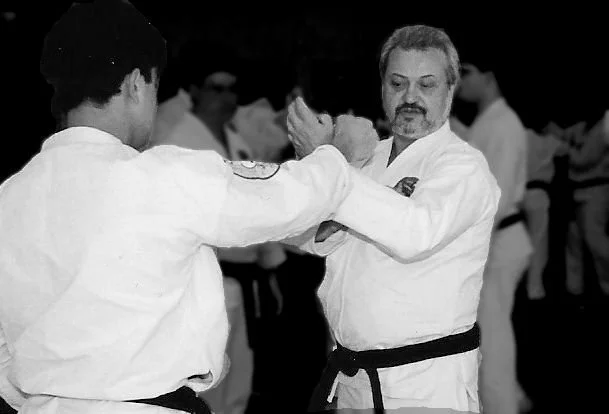
Head Instructor, S. Musco, began his Isshinryu karate training in 1974 under Mr. D. Jenkins until his passing in 1984, Since 1991, he’s continued his studies with Mr. A.J. Advincula, a first generation student of the style’s founder, Tatsuo Shimabuku.
Today, as a 9th Degree Black Belt, Mr. Musco is among the highest ranking practitioners of Isshinryu karate, continuously teaching since 1979 and professionally since 1986.
In 2010, in response to growing commercialism in the martial arts training industry, EMKA was reorganized under Martial Promise, Inc., as a 501c3 nonprofit corporation. This was in an effort to codify, into the future, the dojo’s founding mission: To preserve and promote the classic tradition of martial arts education and its associated culture.
Since the 1970’s boom, most Americans never seemed able to quite grasp of what uses martial arts are for- so they made some up. Alternately characterized as street defense, sport, recreation, exercise, weight loss, and child entertainment, martial arts training is packaged and sold the same way as (and thus categorized along with) dance studios, boxing gyms, spa memberships...
While popularly accepted today, all of these interpretations miss the mark. Badly. Here are two examples:
#1 “Karate is for sport or street-fighting.” Short-sighted. A martial art is first and foremost - as the name implies - an art. An art of body mechanics, awareness, introspection, self-realization, and empowerment. Reducing karate to a competitive activity has more to do with comparing artists than athletes, And yes, karate is an effective form of self-defense - which we insist is a result of the training, but not its greater objective.
#2 “You need to be in shape to begin karate training.” Not so. Effective self-defense for the average person, man or woman, young or old, was was the original mission of the art, but apparently not of movie makers.
Founded on the principle that learning should be as nuanced and captivating as the subject itself, our program elevates instruction and practice to that art form. We don’t spend an inordinate amounts of time on pointless, repetitive drills that have more to do with calisthenics than skill development.
Our dojo has created (re-discovered?) methods of teaching and practice that not only echo the classic martial arts model, but are in line with modern neuro-scientific principles. In short, we teach in a way that best promotes a path to mastery for anyone, young or old, willing to walk it.
Further, we don’t neglect the philosophical aspect of our art. Our dojo culture a model for the development of character and a sense of community. We also offer a lecture component in our program that’s based on the works of distinguished classical Far Eastern philosophers and educators and presented with real-world insight—ensuring every lesson resonates long after the session ends. For us, scholarship is not merely an accumulation of proverbs and maxims; but wisdom to be cultivated, fostering a community where curiosity meets expertise.
The word dojo has meaning far beyond the today’s commercialized interpretations. So does another rarely used word, budoka - practitioner of an art’s ‘Way’ as well as its function.
We’re, obviously, not for everyone. We know it and we’re looking for those who, like us, can appreciate why that matters.
Begin Your Journey
Call (973) 884-2224 or submit an inquiry today. Our Head Instructor will call to assist you.